
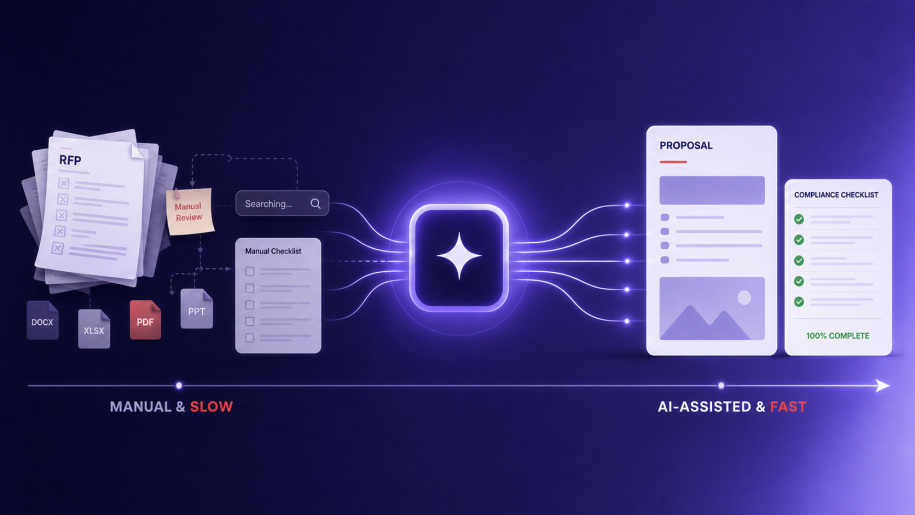
Your best bid manager just spent six hours on an RFP that should have taken six minutes. Somewhere in a 200-page document sits a compliance clause that could disqualify your submission, and nobody has found it yet. The deadline is Friday. This is still how most AI RFP response decisions get made in 2026, manually, under pressure, with too much at stake to move this slowly.
That’s the problem AI is finally solving, and the shift is happening faster than most bid teams realize.
The Old Way Wasn't Built for Today's Volume
Pre-sales and bid teams across the GCC and beyond are chasing more tenders than ever, while RFPs keep getting longer, more technical, and more compliance-heavy. The result is a familiar set of pain points:
Manual review overload: teams lose entire days sifting through lengthy documents just to understand scope
Hidden risks surface too late: a buried eligibility clause or missing certification turns up days before submission, when it’s too late to fix
Misaligned teams: technical, legal, and sales stakeholders each read the RFP differently, and nobody owns the full picture
Missed opportunities: time spent on low-value bids means high-value ones don’t get the attention they deserve
None of this is a people problem. It’s a tooling problem. Reading and structuring dense procurement documents at scale is exactly the kind of task AI was built for, and 2026 is the year it stopped being optional.
What "AI-Powered RFP Analysis" Actually Means Now
The phrase gets thrown around loosely, so here’s what mature RFP response automation looks like in practice, and it’s the exact model WinBid was built around:
Requirement extraction, not just keyword search. Modern tools don’t just find the word “deadline.” They extract scope, compliance requirements, technical constraints, and submission conditions as structured data your team can act on immediately.
Go/No-Go scoring with justification. Instead of a gut call, teams get a structured score with clear reasoning behind it, so the decision to pursue or pass on a bid is defensible, not just intuitive.
Knowledge base grounding. The best systems connect to your company’s own documents, past proposals, and product sheets, so every analysis reflects your actual capabilities and past wins, not generic AI guesswork.
Bilingual and region-specific support. For teams operating across the GCC and MENA, Arabic-English bilingual output isn’t a nice-to-have. It’s the difference between a tool that fits your workflow and one that creates extra translation work.
Faster technical proposal drafting. AI-generated structured content gives proposal writers a real head start instead of a blank page, cutting the time between “we’re in” and “submission ready.”
What to Look For If You're Evaluating AI Bid Tools in 2026
If your team is comparing options, a few questions will tell you more than any feature list:
Does it extract structured, checkable requirements, or just summarize the document?
Can it connect to your existing knowledge base, or does every analysis start from zero?
Does it support Arabic and English natively, or is translation an afterthought?
Can it auto-answer RFP questionnaires using your own knowledge base, or does someone still have to type out every response by hand?
Can it generate a usable draft of a technical proposal, not just an analysis report?
Tools that check all five are solving the real problem. Tools that check one or two are solving a narrower one, and your team will still be doing the rest manually. WinBid was built to check all five, from structured requirement extraction and knowledge base grounding to native Arabic/English output, RFP questionnaire answering, and technical proposal drafting.
The Bottom Line
AI isn’t replacing bid managers, sales teams, or technical reviewers in 2026. What it’s replacing is the hours spent manually reading, extracting, and cross-checking information that should have been structured from the start. The teams pulling ahead this year aren’t the ones with the most people. They’re the ones who’ve handed the repetitive, error-prone parts of RFP response to AI, so their experts can spend their time on strategy, pricing, and relationships, the parts of bidding that still need a human judgment call.
The RFPs aren’t getting shorter. The tools finally are catching up.
See It on Your Own RFPs
WinBid is built for pre-sales and bid teams who need faster, more confident Go/No-Go decisions, without adding headcount. From AI-powered RFP analysis to technical proposal generation and bilingual Arabic/English reporting, WinBid turns your next RFP into a structured, actionable brief in minutes instead of days.
Start your free trial and run your first analysis today.
Leave a Reply